
I had been planning to visit Colombia for a while, but, as usually happens, other opportunities came up along the way, friends inviting us to visit them in another country, work commitments and other trips getting in the way… But we finally managed to fulfill our dream of finally exploring our South American neighbor.
With only a few days to visit Colombia, we wanted to make the most of our time.
If you live in the US, Canada or Brazil, Colombia may seem like a small country, but it’s actually quite large, with so much to offer. There are beautiful landscapes, charming historic towns, bustling cities, beautiful beaches, and, as is often the case in larger countries, it takes time and planning to get from one place to another.
So we decided to focus on a few key locations to avoid long drives and too many hours in airports. We knew there would be future opportunities (and plenty of reasons) to return to Colombia and explore what we missed this time around.
Our itinerary covered three main destinations: Bogotá, Cartagena and Santa Marta (Tayrona National Park). We rented a car only for the stretch between Cartagena and Tayrona, and flew between the other locations.
Colombia in 12 days
How we split it: three nights in Bogotá, four in Cartagena, three next to Tayrona National Park and the last night back in Bogotá, by the airport.
Where to sleep in Bogotá: at Hotel Estelar Parque de la 93, in the north of the city; if you’d rather be in the historic center, try Hotel Casa Deco, in La Candelaria. On our last night we stayed at Hotel Habitel, next to the airport.
Where to sleep in Cartagena: inside the walled city, so you can walk everywhere. We rented an apartment; for a hotel, Hotel Boutique Casona del Colegio or, for less, Hotel 3 Banderas.
Where to sleep in Tayrona: Finca Barlovento Maloka, just a few minutes from the park’s main entrance. It was the best place we stayed on the whole trip.
Getting between cities: fly from Bogotá to Cartagena; from Cartagena to Tayrona it’s about four and a half hours by rental car; from Santa Marta, fly back to Bogotá.
Main tour: a day on the Rosario Islands and Playa Blanca.
Before you go: Tayrona National Park closes three times a year (in 2026: February 1 to 15, June 1 to 15 and October 19 to November 2), so check the dates before you lock in your itinerary.
First of all, follow me on Instagram @danae_explore – that’s where you can keep up with my trips, find lots of travel tips, and send me a DM anytime. I love chatting about travel!

Colombia 12-Day Itinerary Overview
Day 1 – Arrival in Bogotá, lunch and a first walk around Parque de la 93 and the surrounding area. Our base for these first days was Hotel Estelar Parque de la 93
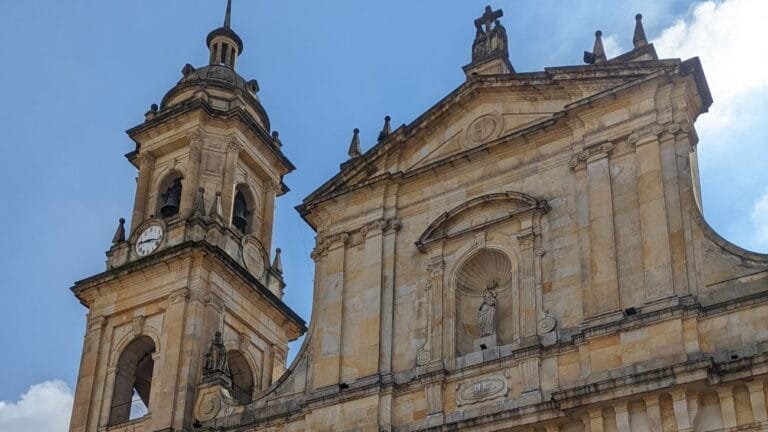
Day 2 – explore Bogotá’s historic center at a relaxed pace
Day 3 – Bike tour around the city (or you can visit to the Zipaquirá Salt Cathedral)
Day 4 – Morning around Parque de la 93 and an afternoon flight to Cartagena. There, we stayed for the next few days in an apartment within the Ciudad Amurallada
Days 5 and 6 – Time to enjoy Cartagena
Day 7 – Day trip to Islas del Rosario
Day 8 – We picked up our rental car and drove to Tayrona National Park; we spent the rest of the day relaxing by the pool and on the beach at Finca Barlovento Maloka Hotel
Days 9 and 10 – Hiking and beaches at Tayrona National Park
Day 11 – We headed to Santa Marta, explored the town, and in the late afternoon returned the car at the airport and took a flight back to Bogotá, where we spent the last night at Hotel Habitel, next to the airport
Day 12 – Last morning in Bogotá; afternoon flight to our next destination
How to get to Colombia
We started our journey in São Paulo, Brazil, where Avianca offers direct daily flights to Bogotá. Avianca connects Colombia with several cities around the world, especially in the Americas and Europe.
Flying with Avianca was very smooth, we had flown with them before on trips to Costa Rica and Curaçao, and everything went smoothly. Depending on the season, there are also direct flights to other Colombian cities.
On top of being easy to reach and relatively affordable — much cheaper than the United States or Western Europe — Colombia is a great destination, with diverse attractions, beautiful beaches, rich history and culture, delicious cuisine, and pleasant weather year-round.
November 2026 update: before flying in, every visitor must fill in Colombia’s free Check-Mig form, between 72 hours and 1 hour before the flight; immigration may also ask for your onward ticket and hotel booking.
To call an Uber and use maps without relying on Wi-Fi, an eSIM like the ones from Airalo sorts it out before you even fly.


Bogotá
Our Colombian journey started in the country’s capital, Bogotá.
Despite being close to the equator, Bogotá sits at an altitude of 2,600 meters, which gives it mild temperatures year-round. We visited in January — summer in the southern hemisphere, though Bogotá is in the northern hemisphere — and the weather was perfect: sunny and pleasantly warm during the day, with a refreshing chill in the early morning and evening.
Check out this post for a detailed breakdown of everything we did in 3 days in Bogotá.
Where to stay in Bogotá
For our stay in Bogotá, we wanted to experience the city more like locals, so we chose to stay away from the main tourist areas. After some research, we decided on the northern part of the city — Chapinero, Chicó, and Parque de la 93.
We stayed at Hotel Estelar Parque de la 93 and had a great stay. The hotel is close to several restaurants, bars, shops and cafés, and the neighborhood is lovely. It was exactly what we wanted: a relaxing, peaceful base to enjoy the city.
If you prefer to stay in the historic center, a popular choice among tourists is the La Candelaria neighborhood, which offers several options, usually with great value for money, such as Hotel Casa Deco, Arche Noah Boutique Hostel, and Hotel Casa de la Vega.
What to do in Bogotá
We spent 2 full days and 2 half days in Bogotá: arriving around lunchtime on our first day, staying for two more full days, and heading to the airport around noon on our last day.
For a complete guide to Bogotá, including what to do, where to eat, which local dishes to try, and the best day trips, check out my detailed post. It’s definitely worth a read!


Cartagena de Indias
How to get to Cartagena de Indias
We took a quick 1-hour flight from Bogotá to Cartagena with VivaAir (which has since gone bankrupt), a local low-cost airline. Cartagena’s airport is conveniently close to the city, so we opted for a taxi upon arrival.
Where to stay in Cartagena de Indias
For our stay in Cartagena, we decided to switch things up and booked an Airbnb instead of a hotel (unlike our stays in Bogotá and Tayrona, where we opted for hotels). We wanted more space and the option to do laundry, which is essential when traveling with just a carry-on — doing laundry along the way is a must.
We found a lovely apartment in the historic center (Ciudad Amurallada), just steps from the city walls. It was perfect for our family of four and offered easy access to the famous Café del Mar.
In my detailed Cartagena post, I’ve included great accommodation suggestions in the historic center. In addition to those, I also recommend, for a higher-end stay, Hotel Boutique Casona del Colegio, and for more budget-friendly options, Hotel 3 Banderas and Hostal Casa Torres.


How to get around Cartagena de Indias
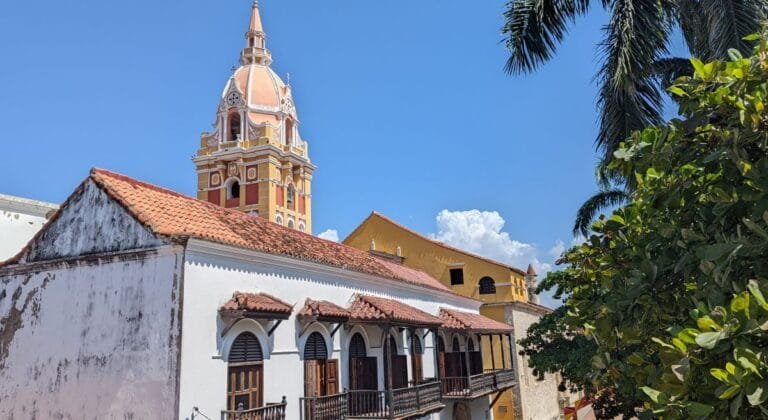
If you’re staying in the Old Town (Ciudad Amurallada), you can easily explore everything on foot. The historical part of town is small and pleasant, and Getsemani, another historic neighborhood in Cartagena, is also very close. It’s a great place to walk around, grab a coffee or ice cream, and, of course, take lots of pictures. We walked everywhere, covering quite a bit of ground, even though we did everything under the intense sun, with temperatures consistently above 30°C.
What to do in Cartagena de Indias
It’s important to note that Cartagena doesn’t really have beaches within the city itself, despite its location on the Caribbean coast. The sea can be rough, and there are only a few small stretches of sand. During our drives to and from the airport, we noticed that these areas were typically crowded with chairs, umbrellas, and people. The water didn’t look particularly appealing — quite a contrast to the idyllic Caribbean image we often have.
If you’re looking for that dream Caribbean experience, you’ll need to visit the nearby islands and beaches further out, as I explain in more detail in my detailed Cartagena post.
We spent three and a half days in Cartagena: arriving late in the afternoon on our first day, spending three full days (including one dedicated to visiting the Islas del Rosario), and on our last day, after breakfast, we picked up a rental car and drove to Tayrona National Park.
In this post, I share all the details of everything we did in Cartagena, what we loved, and what didn’t quite meet our expectations. Check it out!
To rent a car, I always use RentCars, where I usually find the best options, and with the DANAE promo code you still get an additional 5% off. Shall we go?

Tayrona National Park
How to get to Tayrona National Park
On our last day in Cartagena, we rented a car from an Alamo branch near the airport and drove to Tayrona National Park, which is about 250 km east — just over a 4-hour drive, not counting our lunch stop.
We stopped for lunch at Isla Rosario (not to be confused with Islas del Rosario near Cartagena; this one is between Barranquilla and Santa Marta) at the rustic but delicious and beautifully located Popeye El Marino Restaurant. However, it’s worth noting that the restaurant is in a very simple and underdeveloped area, which felt like the most precarious place we passed on the way between Cartagena and Tayrona.
Where to stay near Tayrona National Park
The main town close to Tayrona National Park is Santa Marta, where you’ll find several accommodation options for all budgets and travel styles. However, it takes about an hour to drive from the city center to the park entrance, covering roughly 40 km. Although the drive is easy, we wanted to enjoy the beach, the hotel, and the park itself, so I looked for options closer to the entrance to make the most of our time.
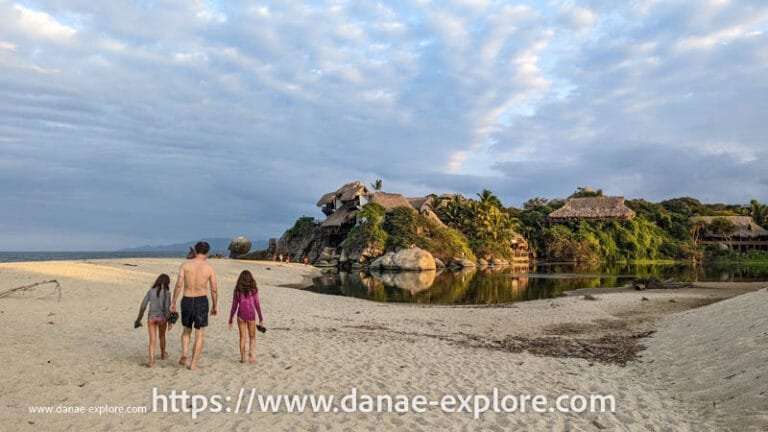
We stayed at Finca Barlovento Maloka, one of the properties within Finca Barlovento. I can’t emphasize enough how special the location is. Set right at the mouth of the Piedras River, which marks the boundary of Tayrona National Park, the property is practically on the beach. Another option within the same complex, Finca Barlovento Cabaña, is literally built above the rocks where the waves break.
The property itself is simple but comfortable and cozy. The balcony overlooking the river and the sea is amazing, and the restaurant serves delicious food with very attentive staff. The pool, tucked into the forest, is a great place to relax, and there’s also a spa (which we didn’t try). Overall, this was the best place we stayed during the trip and one of the best in recent years.
Despite highly recommending Finca Barlovento Maloka (and honestly dreaming of going back), there are other great places to stay around Playa Los Naranjos.


What to do in Tayrona National Park
If you love nature and adventure, Tayrona is a must-visit. The park spans from the Sierra Nevada mountains to the Caribbean coast, offering a mix of beaches, forests, desert landscapes, and mountains. We focused on the coastal areas, but there’s much more to explore.
One of the highlights of our time in Tayrona National Park was hiking from Cañaveral to Cabo San Juan del Guia. The trail winds through lush forest, rocky cliffs, and gorgeous beaches. Although the hike is long and has a few challenging sections, it’s absolutely worth it. Our kids, ages 9 and 10, managed it with a bit of complaining, but they made it all the way.
The views are breathtaking, and Cabo San Juan del Guía rewards you with a beautiful beach and crystal-clear water. We spent time relaxing, swimming, and enjoying the scenery. A tip: bring plenty of water, sunscreen, and wear proper hiking shoes — my flip-flops didn’t survive the hike.
To learn more about our three days in Tayrona Park and get practical tips for visiting the park, check out the full post.
November 2026 update: the entrance fee for foreign visitors is 81,000 Colombian pesos in low season and 96,500 in high season (December 1 to January 31, June, July, Holy Week and long weekends), plus mandatory insurance bought at the gate. There are no reservations: tickets are sold on the day until the daily capacity is reached. And the park closes three times a year; more in our Tayrona guide.
How to get from Tayrona National Park to Bogotá
On our last day, we left the hotel early and drove to Santa Marta. We had lunch in town and then headed to the airport, where we returned the rental car. There was an extra fee for dropping it off in a different location, but we did the math and it was the only way to avoid losing a full day traveling — not to mention saving on an extra night, fuel, and meals.
We flew to Bogotá with VivaAir, a local low-cost airline (now bankrupt). The flight departed at 4:30 pm and landed in Bogotá at 6:00 pm.
The next day, we took an Avianca flight to Orlando, USA — a direct three-and-a-half-hour flight.
If we’d had more time, we would have added the Jardín, Salento and Cocora Valley area: you can visit Jardín on a day trip from Medellín and, from Salento, do the Cocora Valley hike. And if you want to continue to Central America, Belize’s Caribbean and Guatemala are just a flight away from Bogotá: see things to do in Belize and our 10-day Guatemala itinerary.

Colombia itinerary FAQ
How many days do you need in Colombia?
With 12 days, like we had, you can see Bogotá, Cartagena and Tayrona National Park without rushing. If we’d had more time, we would have added Jardín, Salento and the Cocora Valley, in the coffee region.
Is 10 days enough for Colombia?
Yes, for this route: drop one night in Cartagena and the last night in Bogotá. With less than that, pick either Bogotá and Cartagena or Cartagena and Tayrona.
How do you get around between Bogotá, Cartagena and Tayrona?
Fly between Bogotá and the coast (about 1.5 hours) and go by car or transfer between Cartagena, Santa Marta and Tayrona. We rented a car in Cartagena and dropped it off at Santa Marta airport.
What is the best time to visit Colombia?
On the Caribbean coast, December to March is the driest season, and December and January are peak season (pricier and busier). Bogotá is mild all year. We went in January and had great weather the whole trip. Check Tayrona’s closure dates before you book.
Is Colombia safe for travelers?
In our experience, yes, with the usual precautions: use Uber or taxis booked through your hotel at night and keep your phone out of sight in crowded areas. A yellow fever vaccine is also recommended, especially for the Santa Marta and Tayrona area; get it at least 10 days before you travel.
Plan your trip
The websites I always use to plan my trips. Booking through these links costs you nothing extra and helps keep the blog going.