
Belize is the perfect destination for travelers who want a bit of everything: adventure, culture, history, and a healthy dose of relaxation.
This small country, the second smallest in mainland Central America, packs an impressive amount into a small area. From crystal-clear waters teeming with marine life and caves hidden beneath the jungle, to Mayan ruins and the colors and flavors of Caribbean culture, Belize offers breathtaking scenery and a rich cultural mix that leaves you wondering why it took so long to visit.
We visited as part of a combo trip with Guatemala, spending ten days there before crossing into Belize for a week, and it ended up being one of our favorite family trips back when the girls were little.
This trip marked a turning point for us. Visiting a country with a reputation for being “dangerous” and another we barely knew anything about, it was here that we realized family travel could be so much more than theme parks, all-inclusive resorts, and the classic Europe itinerary. Our perspective shifted — and we never looked back.
Whether you’re traveling with kids or flying solo, here’s your one-week Belize itinerary.
First of all, follow me on Instagram @danae_explore – that’s where you can keep up with my trips, find lots of travel tips, and send me a DM anytime. I love chatting about travel!
Belize
How long to stay: one week, with 2 nights in San Ignacio (jungle and Mayan ruins) and 4 nights in San Pedro, on Ambergris Caye (beach and reef).
Where to stay: Cahal Pech Village Resort in San Ignacio and Xanadu Island Resort in San Pedro.
What we loved most: climbing El Castillo at Xunantunich, cave tubing, and swimming with nurse sharks on a Hol Chan and Shark Ray Alley snorkel tour. More on each one in our guide to things to do in Belize.
When to go: December to April, the dry season. For Christmas and New Year’s, book hotels and tours months ahead.
Entry: most travelers, including US, Canadian, UK and EU passport holders, don’t need a visa. Leaving by land, the exit fee is BZ$40 (US$20), cash only.

Belize one-week itinerary overview
Our one-week Belize itinerary worked out really well and gave us a good balance between jungle adventures and island time. We split our stay between two bases: San Ignacio, on mainland Belize, and San Pedro, on Ambergris Caye. This way, we didn’t have to keep packing and changing hotels.
Day-by-day itinerary:
1️⃣ Arrive by land from Guatemala, visit the Xunantunich ruins; overnight in San Ignacio at Cahal Pech Village
2️⃣ Explore the Cahal Pech ruins and the Iguana Conservation Center (option: visit the El Caracol ruins)
3️⃣ Go cave tubing, travel to Belize City, and take a boat to Ambergris Caye; overnight in San Pedro at Xanadu Island Resort
4️⃣ to 6️⃣ Ambergris Caye
7️⃣ Head to Guatemala City (check out our Guatemala post here)
If you have less time, consider cutting one day from San Ignacio and one from Ambergris Caye. If you’re more into jungle adventures than beach days, add a day in San Ignacio and spend one less day on Ambergris Caye.
For more details on activities in each location, check out our post on what to do in Belize – the best of San Ignacio, Ambergris Caye and Caye Caulker.
Ambergris Caye is an island in Belize in the Caribbean Sea. Nearby, Caye Caulker is smaller, more laid-back, and has a charm of its own. In our post about what to do in Belize you’ll find more information about both islands to help you decide where to stay.

How to get from Guatemala to Belize (and vice versa)
As I mentioned in the Guatemala itinerary post, we decided not to rent a car and instead relied on a mix of public transportation and private transfers. It wasn’t easy to find reliable information, but don’t worry, I’ll break everything down here.
Belize and Guatemala share a 266-kilometer border, a relatively straightforward line that separates Belize to the east and Guatemala to the west. However, the history between the two countries is a bit more complicated. In 1859, a treaty defined the boundaries between them, but Guatemala still claims about 11,000 square kilometers, nearly half of Belize’s current territory, so the dispute remains unresolved. Despite this tension, crossing the border was surprisingly easy and stress-free.
If you prefer renting a car, go for it! I always use RentCars, where I usually find the best options, and with the DANAE promo code you still get an additional 5% off. Shall we go?
Getting from Guatemala to Belize
Our last stop in Guatemala was Tikal, where we stayed at the Hotel Jaguar Inn Tikal, conveniently located next to the Mayan ruins. I highly recommend this hotel (or one of the few others nearby), but one thing to keep in mind: it’s quite isolated, with no town nearby. The closest town is Flores, where most visitors usually stay.
To use public transportation, we would first have needed to take a shuttle to Flores, about an hour away, and then catch a bus from there. We didn’t think the extra backtracking was worth it, so instead we arranged a shuttle directly to our next destination, San Ignacio in Belize, through Hotel Jaguar Inn Tikal.
After breakfast, our driver was already waiting for us to take us to the Belize border. We got out there and handled the border crossing on foot: exit stamp from Guatemala, a short walk of about a hundred meters, and then entry into Belize. There’s no entry fee, but there is an exit fee (US$20 when crossing by land; by air, it’s usually included in the ticket price). Update, November 2026: the land exit fee is still BZ$40 (US$20), paid in cash at the border, and it includes the PACT conservation fee. Belize also has a digital immigration and customs form you can fill in before your trip on the Belize Immigration website.
With our passports stamped, we said goodbye to our Guatemalan driver, and a Belizean driver was waiting for us on the other side. From there, it took about 30 minutes to reach our first stop in Belize, the Mayan ruins of Xunantunich. Our driver waited while we visited the site and then took us to our hotel in San Ignacio, the Cahal Pech Village Resort.


Getting from Belize to Guatemala
Our final day in Belize was all about figuring out how to get from Ambergris Caye to Guatemala City, where we had an early morning flight home the next day.
I looked into flights first, since they were clearly the easiest and fastest option. However, there’s only one flight from Belize City to Guatemala City, operated by TAG, and at the time the one-way ticket cost more than a round-trip flight from São Paulo to Guatemala City (Tropic Air now flies the route too, but it’s still far from cheap). Needless to say, I wasn’t paying that. So we chose the more adventurous route, which at least promised a good story later.
I booked a flight from Flores, in Guatemala, to Guatemala City, without fully knowing how we’d get back to Flores in time for the flight.
In true backpacker spirit, we figured we’d work it out along the way. And somehow, it all worked out fine.
We left our hotel early, took a van to the pier, and then caught the ferry to Belize City. We traveled in March, which is high season but not peak season, and had no trouble buying ferry tickets on the spot without reservations. These days you can buy water taxi tickets online, and over Christmas and New Year’s it’s worth booking ahead.
Once we arrived in Belize City, we caught a bus to Flores directly from the ferry terminal. It was one of those very classic Central American buses: bags tied to the roof under a tarp, everyone squeezed into the hot, stuffy seats with the windows wide open, doing our best not to melt in the heat.


The border procedures were the same as on our way in: exit Belize (paying the US$20 exit fee), walk across to the Guatemalan side, enter Guatemala, and then re-board the bus, now with a Guatemalan driver waiting just beyond the border.
As expected, though, the bus was already running behind schedule. If we had gone all the way to the bus station in Flores and then taken a taxi to the airport, we would have missed our flight to Guatemala City and, consequently, our international flight home the next day. I checked Google Maps and realized the bus route passed right by the airport, so I asked the driver if he could drop us there instead. Not only did he agree, but he even climbed onto the roof to untie our bags before securing the rest of the luggage back in place. Such a kind guy, probably amazed by these crazy travelers hauling two little kids around Central America.
Things were a bit chaotic at the airport, but we made the flight. Once we landed in Guatemala City, we grabbed a taxi to our hotel, the Meraki Boutique Hotel. Five different modes of transportation, more than fifteen hours on the move, all in a single day. We survived, and it became another one of those travel stories we still talk about today. It also reinforced something we had started discovering on that trip: traveling with kids can absolutely include a sense of adventure, flexibility, and yes, occasionally a little discomfort.
If you’d rather avoid some of the improvisation we embraced on this trip, here are some transportation options from Belize to Flores that can be booked in advance.

Where to stay in Belize
Where to stay in San Ignacio
In San Ignacio, we spent two nights at the Cahal Pech Village Resort. It was excellent value for the price, the facilities were great, the girls loved the pool, and the sunset views were beautiful. The hotel is located right in front of the Cahal Pech Mayan ruins, within walking distance.
Other options I considered were the San Ignacio Resort Hotel, which has large rooms and a lovely pool area, and the Yumas Riverfront Lodge, although it’s a bit farther from town.
If you’re looking for a more immersive jungle stay, Belize has some extraordinary options. Blancaneaux Lodge has some of the most charming jungle cabins I’ve ever seen; Gaia Riverlodge is a true dream come to life in the form of a jungle hotel; and Ka’ana Resort & Spa features private casitas surrounded by lush gardens. If you ever stay at one of these, let me know because they look absolutely amazing.
And if sleeping in the jungle is your thing, the Brazilian Amazon has some amazing jungle lodges too: see our guide to Novo Airão and Anavilhanas.

Where to stay in Ambergris Caye – San Pedro
The main town on Ambergris Caye is San Pedro, and if you want to stay close to restaurants and local shops, this is the best area to stay.
We stayed at Xanadu Island Resort, which had a spacious two-bedroom apartment with a full kitchen and a large living room. The pool wasn’t huge, but it was perfect for the girls to have fun.
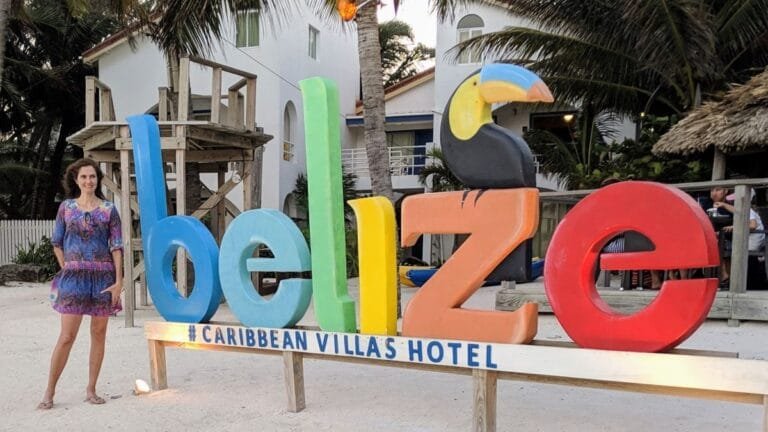
Ambergris Caye has accommodation options for every budget and travel style. Alaia Belize was still under construction during our stay but already looked gorgeous, as did Victoria House Resort & Spa. For more budget-friendly options, consider the Caribbean Villas Hotel or, right in downtown San Pedro, La Casa de Paz Hotel and Hotel del Rio.
When to visit Belize
The dry season runs roughly from December to April (it’s driest from February to May), and the rainy season from June to November. The Atlantic hurricane season runs from June 1 to November 30, with the highest risk from August to October.
December and January kick off the high season: warm days, cooler nights and good snorkeling conditions most of the time. Every now and then a cold front rolls in and brings a few days of rain and choppy seas, and longer boat trips such as the Blue Hole can be canceled.
Christmas and New Year’s are the busiest weeks of the year in Belize. Hotels themselves recommend booking 6 to 12 months ahead, prices peak from mid-December to mid-January, and tours with limited spots, like ATM Cave, sell out. If you’re traveling then, book your hotel, water taxis and tours before you go.
We went in March, which is also dry season, and it was great for ruins and jungle. Sargassum is another story, and I tell you all about it below.

Sargassum in Belize
Belize, like several destinations in the northern Caribbean, does deal with sargassum.
This type of seaweed can accumulate in large amounts, drifting across the sea before eventually washing ashore with the currents.
Once it reaches the beach, it starts decomposing and creates piles of organic matter that produce a strong sulfur-like smell, similar to rotten eggs.
Unfortunately, even the nicest hotels can only do so much when it comes to cleaning the beaches. There’s simply too much seaweed. It’s like trying to shovel snow during a snowstorm: one moment the beach is clear, and shortly after, more sargassum washes in. It’s a nonstop cycle, and every morning brings fresh piles of seaweed. Swimming can also be difficult when there’s a heavy buildup.
We visited Belize in March and dealt with quite a bit of sargassum. I can’t say whether there’s a specific season when it’s less intense or if it varies significantly from year to year. According to locals, we may simply have had bad luck, although it seems there’s usually at least some sargassum year-round. Some days the smell was stronger, while on others it was barely noticeable, probably depending on the direction of the wind.
Belize’s National Meteorological Service offers a “Sargassum Forecast“ which is worth checking before your trip. As I write this, the forecast shows a low probability of sargassum and minimal impact.
Update, November 2026: 2025 and 2026 brought record sargassum seasons to the western Caribbean, with the worst of it between March and September. From November to February there’s usually much less, but it’s not guaranteed: seaweed was already washing up in Belize in January 2026. Secret Beach, on the west side of Ambergris Caye, is often spared, and the government now uses barriers and collection boats in San Pedro and Caye Caulker. Check the weekly NMS bulletin before you book.
Would I go back to Belize’s beaches knowing about the sargassum? Absolutely. I loved the tropical atmosphere of the islands, our excursions were unforgettable, and we still found beautiful beaches untouched by the seaweed. To me, a beach trip is about much more than lying on the beach and swimming in the ocean. It’s about the weather, the scenery, the food, the warmth of the local people, and all the adventures, both on land and at sea, that come with the destination. And in that sense, Belize absolutely delivered.

Before you go: entry, fees and getting around
Entry: US, Canadian, UK and EU passport holders, among many others, don’t need a visa; the entry stamp is usually valid for 30 days. Bring proof of onward travel. You can fill in the digital immigration and customs form ahead of time on the Belize Immigration website.
Exit fees: BZ$40 (US$20) in cash when leaving by land. When flying out, the departure tax is usually included in your ticket.
Mainland to the islands: water taxis leave from the Belize City terminal and take about 45 minutes to Caye Caulker and 1.5 hours to San Pedro (San Pedro Belize Express and Caribbean Sprinter). Tropic Air and Maya Island Air fly Belize City to San Pedro in 15 to 20 minutes. The boat between the two islands takes half an hour.
Entrance fees (2026): Xunantunich BZ$25, Cahal Pech BZ$20, Caracol BZ$25 and Altun Ha BZ$20 for non-residents; ATM Cave is BZ$60, usually included in the tour price. The Hol Chan Marine Reserve fee has been US$15 since August 2024.
All of this was checked in November 2026; prices and rules change, so double-check before you go.
Currency and exchange rates in Belize
Belize used to be a British colony and only gained independence in 1981. Today, it remains part of the British Commonwealth, and until recently Queen Elizabeth appeared on its banknotes (since 2025, new notes feature national heroes George Price and Philip Goldson, and the old ones are still legal tender). However, the local currency is the Belizean dollar, often shortened to Belize dollar.
The exchange rate is fixed:
US$1 = BZ$2
U.S. dollars are accepted almost everywhere, and it’s very common to pay in one currency and receive change in the other, or even a mix of both.
During our one-week Belize itinerary, we didn’t exchange money at all. We used the U.S. cash we already had and relied on our multi-currency debit card for the rest. By the end of the trip, we had used all our Belize dollars without a single bill left over, not even one to bring home as a souvenir.

Language and safety in Belize
Did you know Belize is the only country in Central America where English is the official language? The local accent is a fascinating mix of British English and Caribbean influences, but we quickly got used to it, and communication quickly became easy.
We had no issues at all with either communication or safety during our trip. Everyone we met was warm and welcoming, and at no point did we feel unsafe.

,
What to do in Belize
For more details and in-depth information about what to do in Belize, check out our full post where we share everything we did, our favorite experiences, and tips to help you plan your trip.
But here’s a quick look at some of the highlights from our one-week itinerary in Belize:
What to do in San Ignacio
Explore Mayan Ruins: Belize is home to several impressive Mayan sites, many of them near San Ignacio, including Xunantunich, Cahal Pech, and El Caracol. In this post, I share more details about each of them. Other fascinating ruins worth visiting include Lamanai, Cerros, Lubaantun, and Nim Li Punit, the latter two often visited together.
Go Cave Tubing and Cave Exploring: One of our favorite experiences in Belize was cave tubing. If you’re looking for something more adventurous, I highly recommend visiting the ATM Cave (Actun Tunichil Muknal). You canread more about it here.

What to do in Caye Caulker and Ambergris Caye
Diving and snorkeling: Belize is home to the largest barrier reef in the Northern Hemisphere and the second largest in the world, making it a dream destination for anyone who loves the ocean.
Spend some time at the beach: On Ambergris Caye, Secret Beach is worth a visit.
Rent a bike: Bike around the island on either Ambergris Caye or Caye Caulker.
Visit the Altun Ha Mayan Ruins: Although located on the mainland, Altun Ha is easy to visit from both Caye Caulker and Ambergris Caye.
You can find more details about all these activities in our full guide on what to do in Belize.
Belize FAQ
How many days do you need in Belize?
A week is enough to see the two most popular areas: two or three days in San Ignacio for Mayan ruins and caves, and four or five on the islands. With less time, pick one of the two; with more, add Caye Caulker, the Blue Hole or southern Belize.
Is December or January a good time to visit Belize?
Yes. It’s the start of the dry season and there’s usually less sargassum than in spring and summer. The trade-off: Christmas and New Year’s are the busiest and most expensive weeks of the year, so book hotels, water taxis and tours well in advance.
Do I need a visa for Belize?
Most travelers don’t, including US, Canadian, UK and EU passport holders; the entry stamp is usually valid for 30 days. If you leave by land, there’s an exit fee of BZ$40 (US$20), cash only.
Ambergris Caye or Caye Caulker?
Ambergris Caye has more infrastructure, hotels and restaurants; Caye Caulker is smaller, simpler and more laid-back. Snorkeling and diving trips leave from both. I compare the two islands in our guide to things to do in Belize.
Is Belize safe for tourists?
We didn’t have any problems, either in San Ignacio or on the islands, and people were welcoming everywhere. As anywhere, use common sense, especially in Belize City at night.
Enjoyed our Belize guide? Check out the blog for tips on what to do in Belize and Guatemala, which we visited on the same trip. And if you have any more questions, feel free to reach out to me on Instagram!

Plan your trip
The websites I always use to plan my trips. Booking through these links costs you nothing extra and helps keep the blog going.